Donate to support Ukraine's independence.
Generated by AI

Fix TLS Trust Errors Between Kubernetes Services with cert-manager and trust-manager

Managing Internal TLS Trust in Kubernetes with cert-manager and trust-manager How do you maintain a secure SSL/TLS connection between services within a Kubernetes cluster? One simple (but unsafe) answer is to create a self-signed certificate and skip verification with a flag like --insecure-skip-tls-verify. A more advanced solution is to use a service mesh (e.g., Linkerd, Istio), which automatically manages certificates and trust. But what if you want something simpler and lighter? That’s where trust-manager comes in. It’s the easiest way to manage trust bundles in Kubernetes and OpenShift clusters. ...
October 27, 2025 · 5 min · 853 words · Serhii Kaidalov
Generated by AI

Automate TLS Certificate Renewal in Nginx Without Certbot

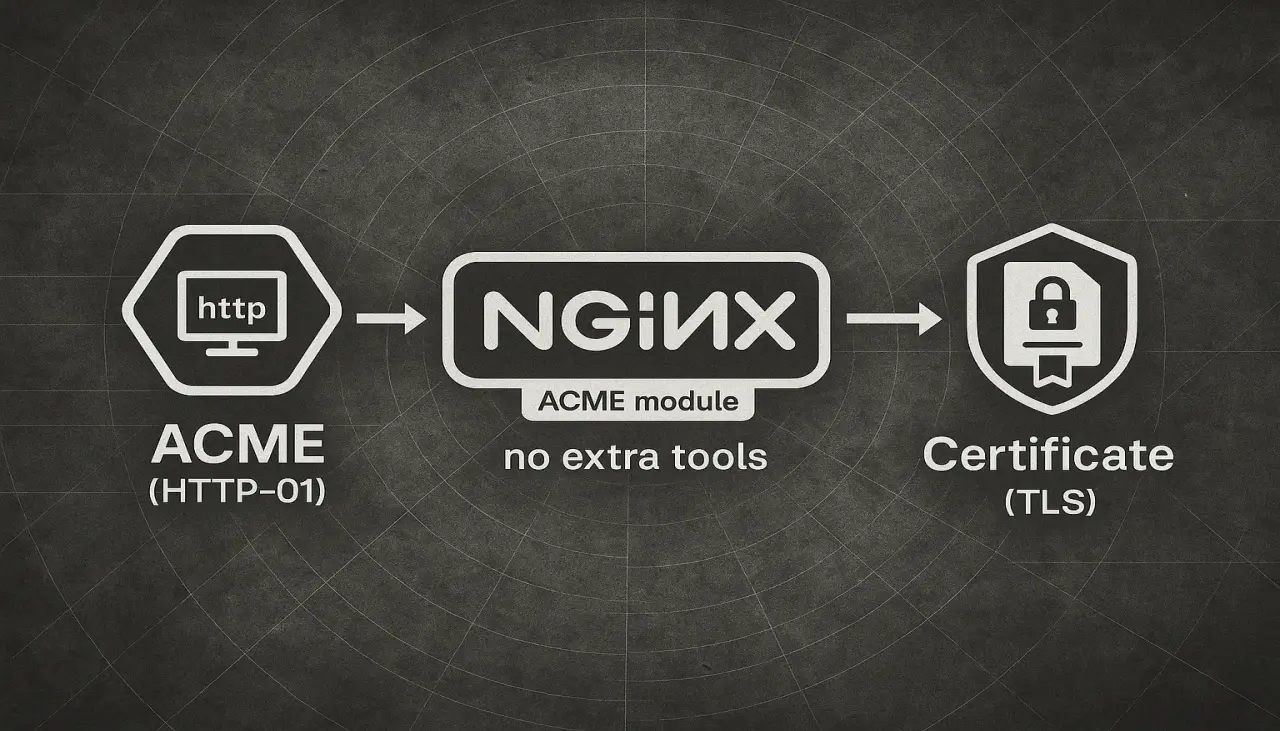
On Aug 12, 2025, NGINX announced native support for the ACME protocol: https://blog.nginx.org/blog/native-support-for-acme-protocol This is a great improvement because you no longer need extra tools to issue SSL certificates. The first release supports only the HTTP-01 challenge, so wildcard certificates are not possible yet. For wildcards you need DNS-01 with DCV delegation . Let’s see how it works. ...

August 17, 2025 · 4 min · 672 words · Serhii Kaidalov
Generated by AI

Issue SSL Certs for Servers That Can't Respond to HTTP Challenges Using DCV Delegation

When you need to get a certificate from a service like Let’s Encrypt, you must validate ownership of the domains for which you are issuing a certificate. This is achieved using challenges. But what types of challenges are available? 1. HTTP-01 Challenge The most common and widely used type is the HTTP-01 challenge. With this method, you receive a token that must be placed in your web server at the following path: ...

January 19, 2025 · 3 min · 578 words · Serhii Kaidalov